New Research Suggests Berberine May Support Healthy Blood Sugar Regulation Naturally
Understanding how berberine improves glucose metabolism through AMPK activation and insulin pathway support.

Introduction: Why Blood Sugar Stability Matters
Blood glucose stability is among the most fundamental indicators of metabolic health. Within a narrow band — roughly 70 to 140 mg/dL across a typical day — almost every cellular process functions efficiently. Outside that band, repeatedly, the cumulative damage compounds across vascular, neural and hepatic tissues over years and decades.
Modern continuous glucose monitoring has made this visible in a way it never was before. We now know that fasting glucose alone is a poor proxy for metabolic health, and that the area under the curve following meals — the glycemic excursion — predicts long-term cardiovascular and metabolic risk more reliably than any single fasting measurement.
Blood Sugar Regulation: The System
Healthy blood glucose regulation is a coordinated effort between the pancreas (which secretes insulin and glucagon), the liver (which stores and releases glucose), skeletal muscle (which consumes the majority of postprandial glucose), and adipose tissue (which buffers excess energy). Insulin is the master signal: in response to rising glucose, the pancreas releases insulin, which instructs muscle and adipose tissue to absorb glucose and instructs the liver to stop producing it.
When this signalling network functions well, postprandial glucose returns to baseline within two hours. When insulin resistance develops, the same meal produces higher peaks, longer excursions, and demands more insulin to clear. Over time, this pattern erodes pancreatic beta cell capacity and progresses toward overt dysregulation.
Insulin Signaling And GLUT4
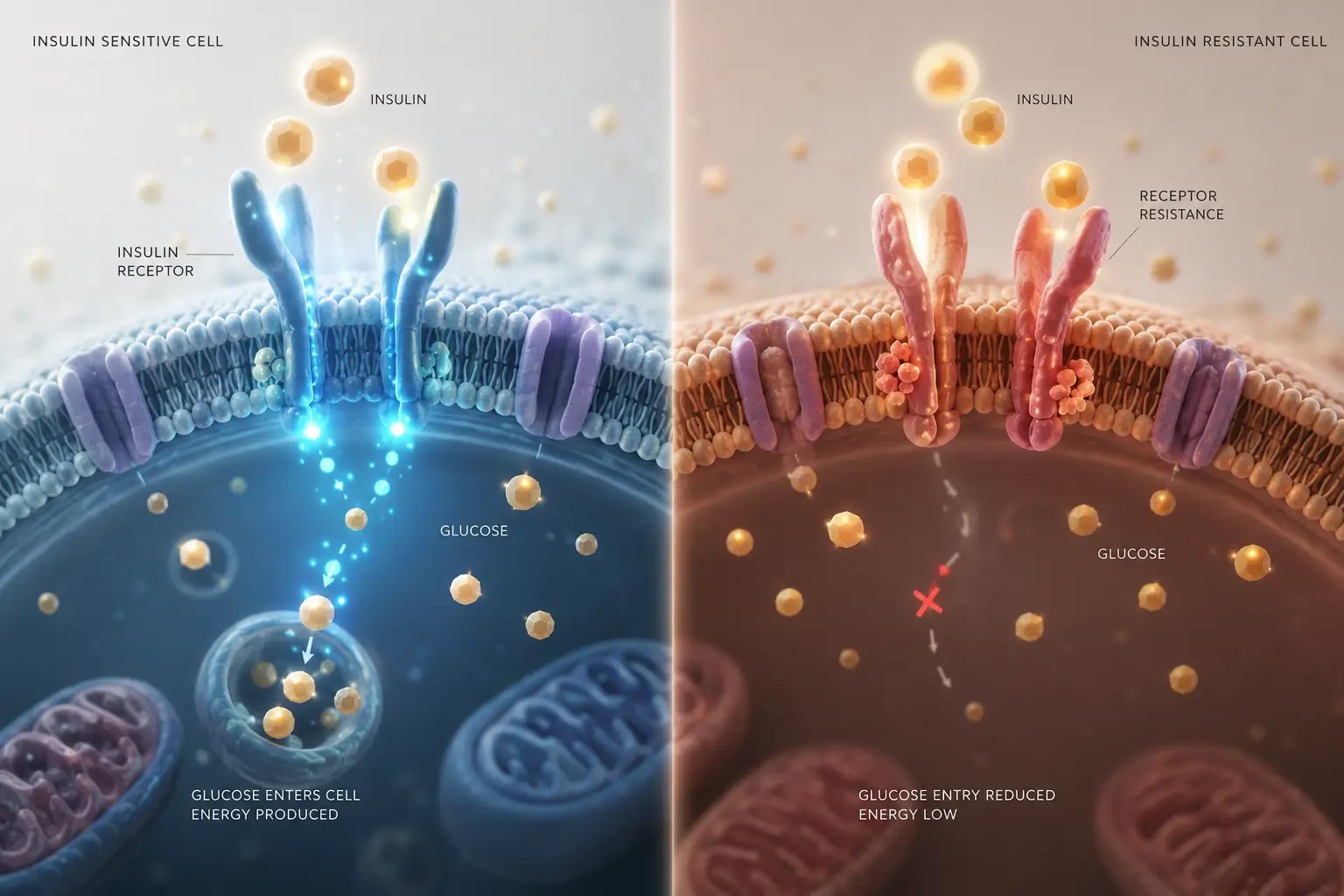
GLUT4 is the principal glucose transporter responsible for insulin-stimulated glucose uptake into skeletal muscle and adipose tissue. Under resting conditions, GLUT4 sits stored in intracellular vesicles. When insulin binds its receptor, a phosphorylation cascade triggers GLUT4 translocation to the cell surface, dramatically increasing the rate of glucose entry.
In insulin-resistant tissue, this translocation is impaired. GLUT4 expression may be reduced, vesicle trafficking may be sluggish, and the post-receptor signalling cascade may be desensitised. The result is that the same insulin signal produces less glucose disposal — and therefore higher and longer blood glucose excursions.
How Berberine Influences Glucose Transport
Berberine has been shown in multiple cellular and animal studies to increase GLUT4 expression and stimulate its translocation to the cell membrane, partially independent of the insulin signal itself. The mechanism is mediated by AMPK activation: once AMPK is switched on, it triggers GLUT4 translocation through a parallel pathway to the canonical insulin route.
This is mechanistically important. It means berberine can support glucose uptake in tissue where insulin signalling has become impaired — exactly the tissue that needs help. The compound also reduces hepatic gluconeogenesis, lowering the inappropriate glucose output that drives fasting hyperglycemia in insulin-resistant individuals.
Why Blood Sugar Spikes Matter
Sharp glucose excursions following meals are now understood to drive endothelial dysfunction, oxidative stress and inflammatory cytokine release. These mechanisms are upstream of atherosclerosis, microvascular damage and the long-term complications associated with chronically elevated glucose. Reducing the amplitude of postprandial spikes — independent of fasting glucose — is increasingly recognised as a meaningful intervention target.
What The Clinical Studies Show
Multiple randomised controlled trials have documented reductions in fasting plasma glucose, postprandial glucose and HbA1c in adults supplementing with berberine 900–1500 mg/day. The DI-2 study and several subsequent trials report mean HbA1c reductions of approximately 0.7%, with corresponding reductions in fasting insulin and HOMA-IR.
Effect size varies with baseline metabolic status. Adults with more pronounced insulin resistance generally show larger absolute improvements. Adults already within a healthy metabolic range show smaller but still measurable shifts in fasting insulin and glycemic variability.
Practical Implications
Berberine's effect on glucose handling is dose-dependent and meal-timing-dependent. Dosing with meals — particularly meals with substantial carbohydrate content — aligns the compound's peak activity with the postprandial glucose curve it is best positioned to attenuate. Splitting the daily dose across two or three meals addresses its short half-life.
- Glucose regulation depends on coordinated insulin signalling across pancreas, liver, muscle and adipose tissue.
- GLUT4 translocation is the rate-limiting step for postprandial glucose disposal in muscle.
- Berberine increases GLUT4 translocation through AMPK, partially bypassing impaired insulin signalling.
- Postprandial glucose excursions drive vascular damage independent of fasting glucose.
- Clinical trials show meaningful improvements in fasting glucose, postprandial glucose and HbA1c at 900–1500 mg/day.
Frequently Asked Questions
How quickly does berberine affect blood sugar?
Acute effects on postprandial glucose can be observed within hours of a dose. Sustained changes in fasting glucose and HbA1c typically require 8–12 weeks of consistent dosing.
Is berberine safe for prediabetic adults?
Berberine has been studied in prediabetic populations with consistent improvements in fasting insulin and glucose. Anyone taking prescription medication should consult a clinician first.
- [1] Lee YS et al. — Berberine, a Natural Plant Product, Activates AMPK — Diabetes, 2006.
- [2] Kim WS et al. — Berberine Improves Lipid Dysregulation in Obesity — Am J Physiol Endocrinol Metab, 2009.
- [3] Zhang H et al. — Berberine Lowers Blood Glucose in Type 2 Diabetes Through Multiple Pathways — Metabolism, 2010.
Beyond Better Research Team. (2026). New Research Suggests Berberine May Support Healthy Blood Sugar Regulation Naturally. Beyond Better Research Library. Retrieved from https://bebeyondbetter.com/research-library/berberine-blood-sugar
Continue Reading.


Better Was Never Enough.
97% HPLC verified purity. Water-only extraction. Full transparency at every batch.